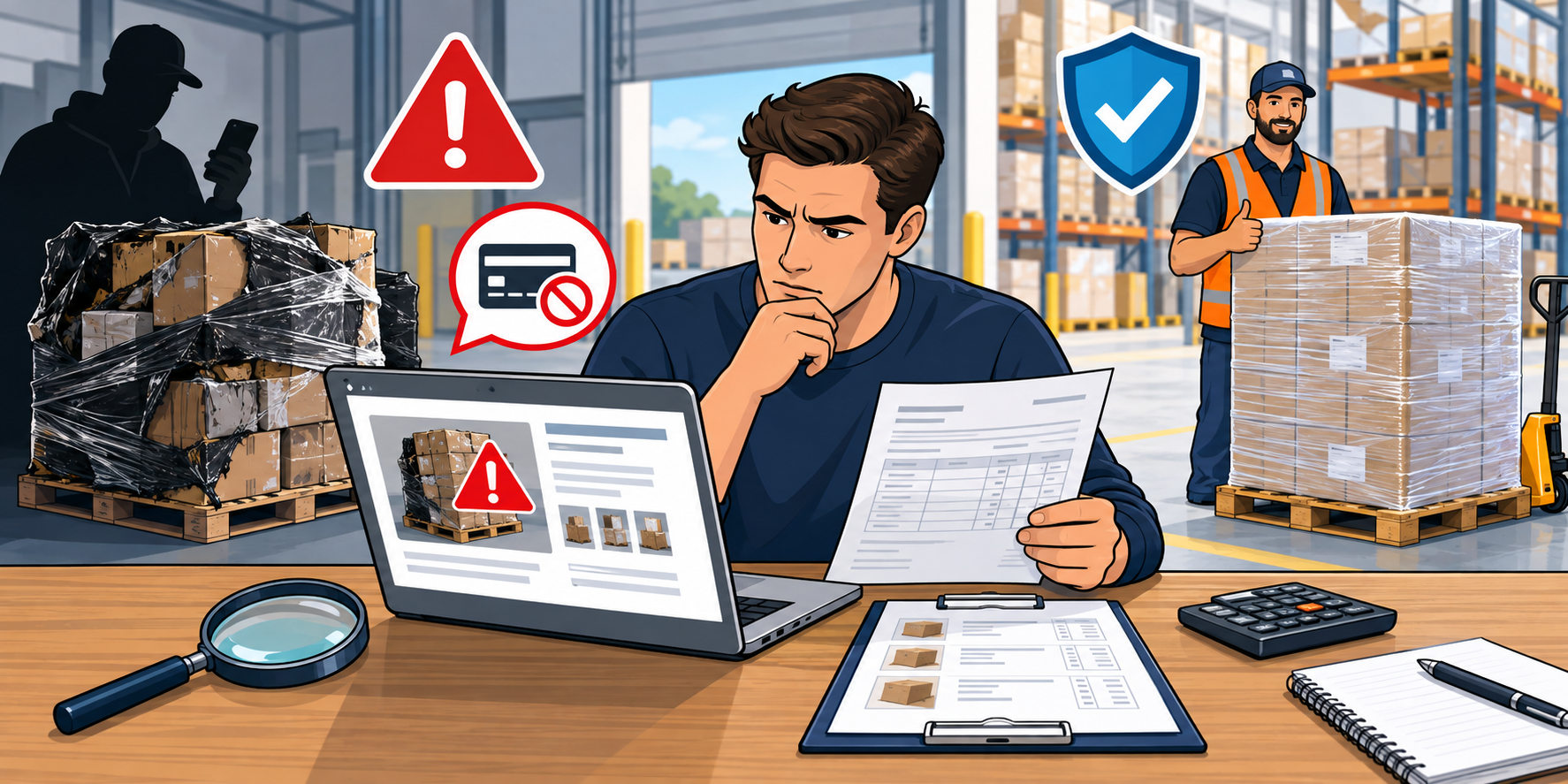

Liquidation Merchandise Conditions Explained
Two liquidation pallets can contain similar products from the same retailer and still deliver completely different results.
One pallet may contain unopened overstock that can be placed directly on a sales floor. Another may contain customer returns requiring inspection, cleaning, missing-part replacement, repairs, and repackaging. A third may be salvage inventory suitable primarily for parts or recycling.
Understanding liquidation merchandise conditions is one of the most important skills a reseller can develop.
Terms such as “new,” “shelf pull,” “open box,” “untested return,” “refurbished,” and “salvage” describe different levels of condition and risk. However, these terms are not always used consistently across suppliers.
Before purchasing any pallet or truckload, read the seller’s exact condition definitions. Never assume that one supplier’s “Grade A” means the same thing as another supplier’s “Grade A.”
Condition, Source and Testing Status Are Different
Liquidation listings often combine three different types of information:
- Source: Why the merchandise entered the liquidation channel
- Condition: What physical or cosmetic state the merchandise is in
- Testing status: Whether anyone has checked its functionality
For example, an item could be:
- A customer return that remains unopened
- An overstock product with damaged packaging
- A shelf pull with cosmetic handling marks
- A customer return that was tested and refurbished
- A new-looking electronic item that has never been tested
- A used product that works correctly
- A salvage product suitable only for parts
The phrase “customer return” explains the product’s history, but it does not tell you whether the product works.
Likewise, “untested” does not automatically mean broken. It means the seller is not representing that the item was tested.
Understanding these distinctions can prevent expensive assumptions.
Quick Liquidation Condition Comparison
| Condition | Typical Description | General Risk | Processing Required |
|---|---|---|---|
| New | Unused merchandise in retail-ready condition | Lower | Minimal |
| Overstock | Unsold excess inventory, often new | Lower | Minimal to moderate |
| Closeout | Discontinued or excess product being cleared | Lower to moderate | Minimal to moderate |
| Shelf pull | Removed from a retail sales floor | Moderate | Cleaning and inspection |
| New damaged box | Unused product with packaging damage | Moderate | Inspection and repackaging |
| Open box | Packaging has been opened | Moderate | Inspection and completeness check |
| Customer return | Product sold and returned by a customer | Moderate to high | Testing, cleaning and possible repair |
| Refurbished | Product inspected and restored to working condition | Moderate | Verification and possible repackaging |
| Used | Product shows prior use | Moderate to high | Cleaning, testing and grading |
| Tested working | Product tested and found functional | Moderate | Cosmetic inspection |
| Tested not working | Known nonfunctional product | High | Repair or parts harvesting |
| Untested | Functionality has not been verified | High | Complete testing |
| Salvage | Heavily damaged, incomplete or nonfunctional inventory | Very high | Repair, parts recovery or disposal |
These are general industry descriptions—not universal guarantees.
New Merchandise
New merchandise generally refers to products that have not been sold to or used by a consumer.
It may include:
- Factory-sealed inventory
- Retail-ready merchandise
- Excess warehouse stock
- Cancelled orders
- Production overruns
- Recently discontinued products
New-condition inventory usually carries less condition risk than customer returns. However, buyers should still inspect for:
- Packaging damage
- Age
- Expired warranties
- Outdated models
- Missing cases
- Price labels
- Retailer markings
- Storage damage
- Resale restrictions
Some suppliers use “new” to describe the product rather than its packaging. The item may be unused even though the box is damaged or has been opened.
B-Stock describes new-condition inventory in one marketplace as unsold merchandise showing no signs of use. Its definitions separately identify like-new, refurbished, used and graded merchandise.
Always determine whether “new” means factory-sealed, unused, retail-ready, or merely without obvious signs of use.
Overstock Merchandise
Overstock is merchandise a retailer, manufacturer or distributor has in excess of current demand.
Overstock can result from:
- Ordering too much inventory
- Seasonal changes
- Forecasting errors
- Cancelled purchase orders
- Warehouse consolidation
- Product-line changes
- Slow sales
- Retail resets
- Packaging updates
Overstock is commonly new and may remain in its original packaging. Via Trading, for example, describes overstock goods as tending to be in new and retail-ready condition.
However, overstock is not automatically profitable.
A product may be overstocked because demand is weak, the model is outdated, the season has passed, or the market is already saturated.
Research current resale prices and sales activity before buying large quantities.
Closeout Merchandise
Closeout merchandise is inventory being cleared from a product line, store, warehouse or distribution system.
Closeouts may come from:
- Discontinued products
- Store closures
- Manufacturer changes
- Packaging redesigns
- Seasonal clearance
- Brand transitions
- Cancelled programs
- Excess production
Closeout merchandise is often new, but the term describes why it is being sold—not its exact physical condition.
A closeout can contain valuable retail-ready inventory, but buyers should consider:
- Product age
- Remaining shelf life
- Warranty availability
- Current consumer demand
- Compatibility with newer products
- Seasonal timing
- Brand or channel restrictions
A discontinued product can still sell well, especially when customers need replacement parts, matching items or products no longer available through regular retailers.
Shelf Pulls
Shelf pulls are products removed from a retailer’s sales floor or store inventory.
They may be pulled because of:
- Seasonal resets
- Packaging changes
- Discontinuation
- Excess store inventory
- Minor packaging damage
- Clearance programs
- Retailer label changes
- Product-line updates
Shelf pulls may not have been purchased by a customer, but they have often been handled.
Possible issues include:
- Price stickers
- Clearance labels
- Security tags
- Dust
- Faded packaging
- Torn boxes
- Dented containers
- Missing packaging
- Cosmetic handling marks
- Incomplete sets
Shelf pulls can be excellent inventory for flea markets, discount stores, local sales, and online resale when the buyer is prepared to clean, inspect and repackage them.
Do not assume that every shelf pull is factory-sealed or suitable for sale without processing.
New Merchandise With Damaged Packaging
“New damaged box,” “new in damaged packaging,” or similar wording usually means the product itself is believed to be unused, but the retail packaging has been damaged.
Packaging damage may include:
- Crushed corners
- Tears
- Water staining
- Removed labels
- Shipping damage
- Opened boxes
- Re-taping
- Missing inserts
The product may still be fully functional and complete, but the damaged box can reduce its resale value.
This condition can work particularly well for local resale, discount retail, flea markets, and platforms where buyers care more about the product than a perfect retail box.
Inspect the item carefully. Packaging damage can sometimes indicate that the product inside also experienced impact, moisture, missing parts, or rough handling.
Open-Box Merchandise
Open-box merchandise has packaging that was opened before the liquidation sale.
Possible reasons include:
- A customer opened the product and returned it
- The retailer inspected the contents
- The product was displayed
- Packaging was damaged
- Accessories were checked
- The box was opened during warehouse processing
Open box does not automatically mean used, complete or functional.
Before resale, check:
- Main product
- Power cords
- Chargers
- Remote controls
- Manuals
- Mounting hardware
- Batteries
- Accessories
- Protective packaging
- Serial numbers
An open-box product missing one inexpensive accessory may still be profitable. A product missing a proprietary charger, remote, stand or major component may be much harder to sell.
Customer Returns
Customer returns are products purchased by consumers and later returned to a retailer.
Customers return merchandise for many reasons:
- Wrong size or color
- Buyer’s remorse
- Duplicate gift
- Delivery damage
- Missing parts
- Product defect
- Difficulty using the item
- Incompatibility
- Changed mind
- Fraudulent return
- Product no longer needed
A customer return may be unopened, lightly used, heavily damaged, incomplete or entirely nonfunctional.
Direct Liquidation notes that customer-return condition can vary because products may be returned for reasons ranging from incorrect size or color to defects or transportation damage.
That uncertainty is why untested customer returns are generally priced below new or overstock inventory.
A customer-return pallet may require substantial processing:
- Identify each product.
- Match products to packaging.
- Inspect for visible damage.
- Check for missing components.
- Test functionality.
- Remove customer information.
- Clean and sanitize the item.
- Grade its condition.
- Photograph defects.
- Price the product appropriately.
- Dispose of unsafe or unusable items.
Customer returns can offer strong margins for buyers who know how to test, repair, complete and resell them. They can be a poor choice for someone expecting every product to be ready for immediate resale.
Refurbished Merchandise
Refurbished merchandise has typically been inspected, tested, repaired or restored to a functional condition.
The refurbishment may have been completed by:
- The original manufacturer
- An authorized refurbisher
- A retailer
- A third-party repair facility
- The liquidation supplier
These sources are not necessarily equivalent.
A professionally refurbished product may include:
- Functional testing
- Replacement components
- Data removal
- Cleaning
- Resetting
- Updated software
- Repackaging
- A limited warranty
However, refurbished items may still have cosmetic wear, replacement packaging, non-original accessories, or a shorter warranty.
B-Stock explains that refurbished merchandise may be restored to working condition while still showing wear or missing original packaging, manuals or accessories.
Ask who performed the refurbishment, what testing was completed, whether accessories are included, and whether any warranty applies.
Used Merchandise
Used merchandise shows evidence of prior ownership, handling or operation.
Suppliers may divide used inventory into condition levels such as:
- Used—like new
- Used—good
- Used—fair
- Used—poor
A used product may be fully functional but have:
- Scratches
- Dents
- Stains
- Fading
- Worn packaging
- Replacement parts
- Missing accessories
- Signs of installation
- Normal wear
The key questions are whether the item functions correctly and whether its cosmetic condition is accurately represented.
Used merchandise should be cleaned, tested and honestly described before resale.
Grade A Merchandise
Grade A usually describes inventory in the best condition within a seller’s grading system.
It may mean:
- New or nearly new appearance
- Minimal cosmetic wear
- Full functionality
- Complete accessories
- Clean screens or surfaces
- Retail-ready or close to retail-ready condition
However, Grade A is not a universal standard.
One supplier may use Grade A only for fully tested electronics. Another may use it for clothing or general merchandise with minimal defects. A third may define it by cosmetic appearance without guaranteeing functionality.
Read the supplier’s grading document before relying on the letter grade.
Grade B Merchandise
Grade B generally indicates functional merchandise with more visible cosmetic wear than Grade A.
Possible characteristics include:
- Light scratches
- Small dents
- Damaged packaging
- Missing nonessential accessories
- Signs of handling or use
- Minor cosmetic defects
Grade B inventory can offer good value when customers care more about function and price than perfect appearance.
It may work well for local marketplaces, used-product stores, discount retail, repair shops, and value-focused online customers.
Grade C Merchandise
Grade C usually indicates heavier cosmetic wear, missing components, uncertain functionality, or products requiring repair.
Possible issues include:
- Deep scratches
- Cracked housings
- Dents
- Missing accessories
- Damaged screens
- Heavy use
- Functional defects
- Parts replacement
Grade C inventory is generally better suited to experienced resellers, repair technicians, exporters, parts sellers, and buyers with low-cost labor.
Profit depends heavily on the seller’s exact definition and the buyer’s repair capabilities.
Grade D Merchandise
Grade D may refer to products with significant defects or items intended primarily for repair, parts harvesting, recycling or salvage.
Possible characteristics include:
- Nonfunctional products
- Severe physical damage
- Missing major components
- Locked devices
- Water exposure
- Broken displays
- Items beyond economical repair
Some marketplaces use additional grades or entirely different grading structures. Never treat Grade D—or any letter grade—as meaningful without reading the applicable condition definition.
Tested Working
“Tested working” generally means someone performed a test and found the product functional.
But you still need to ask:
- Who conducted the test?
- What functions were tested?
- Was the test basic or comprehensive?
- Were accessories used during testing included?
- How long ago was the test completed?
- Is functionality guaranteed?
- Is there a claims period?
For example, turning on a television does not confirm that every input, speaker, network feature and remote-control function works.
The phrase is useful, but the scope of testing matters.
Tested Not Working
Tested-not-working merchandise is known to have a functional problem.
This inventory may be appropriate for buyers who:
- Repair electronics
- Harvest parts
- Rebuild appliances
- Sell replacement components
- Recycle materials
- Export repairable goods
Estimate repair costs conservatively. Some products will have several defects, unavailable parts, account locks, or damage that makes repair impractical.
Untested Merchandise
Untested merchandise has not been verified for functionality.
Untested does not mean working, and it does not necessarily mean broken. It means the functional condition is unknown.
The buyer must be prepared for a mixture that may include:
- Fully functional products
- Products needing simple repairs
- Incomplete items
- Severely damaged items
- Items suitable only for parts
- Products that cannot be safely resold
When pricing untested inventory, never calculate profit as though every item works.
Use conservative recovery assumptions based on the product category, supplier history, return source, visible condition, testing cost and your own experience.
Salvage Merchandise
Salvage is generally the highest-risk liquidation condition.
Salvage loads may contain:
- Broken products
- Heavily used merchandise
- Incomplete items
- Freight-damaged goods
- Water-damaged inventory
- Products with missing packaging
- Items requiring major repair
- Parts-only merchandise
- Unsellable products
- Products requiring disposal
Some retailer marketplaces explicitly sell a combination of overstock, returns and salvage merchandise, making it essential to check the condition attached to each individual listing.
Salvage inventory may be profitable for specialists, but it is rarely suitable for beginners expecting ready-to-sell products.
Buyers must also consider safety, recalls, contamination, hazardous materials, data security, product liability and disposal costs.
As-Is Merchandise
“As is” generally means the buyer accepts the merchandise in its existing condition, with limited or no warranties.
It may also mean:
- No returns
- No exchanges
- No guarantee of functionality
- No guarantee of completeness
- No adjustment for normal condition variance
- Buyer responsible for inspection
- Limited claims period
“As is” does not necessarily allow a seller to intentionally misrepresent merchandise. However, it can substantially limit a buyer’s options when the problem falls within the disclosed transaction risks.
Read the complete terms before bidding.
Retail-Ready Does Not Always Mean Factory-New
“Retail-ready” generally suggests that merchandise can be offered for resale without extensive repair or processing.
However, it may still include:
- Price stickers
- Clearance labels
- Minor packaging wear
- Replacement packaging
- Small cosmetic flaws
- Non-original accessories
Ask the seller what “retail-ready” means within its system.
A pallet described as retail-ready should still be inspected before products are placed on a sales floor or listed online.
Why Condition Definitions Vary
Liquidation merchandise passes through many different systems.
A retailer, manufacturer, auction platform, wholesaler and local pallet seller may each use different terminology. Product categories can also require different standards.
For example:
- Cosmetic grading is especially important for phones.
- Completeness is critical for furniture and assembly-required items.
- Testing is essential for appliances and electronics.
- Expiration and storage conditions matter for food and health products.
- Packaging condition can strongly affect collectible merchandise.
- Safety and recall status matter for children’s products.
This is why a condition label should never replace the listing’s full description and terms.
How Condition Affects Purchase Price
As condition risk increases, the purchase price should generally decrease.
Lower-risk inventory usually costs more because the buyer expects:
- Higher sellable yield
- Less testing
- Fewer repairs
- Lower labor costs
- Easier listings
- Fewer customer complaints
- Faster inventory turnover
Higher-risk inventory should cost less because the buyer must account for:
- Unknown functionality
- Missing parts
- Cleaning
- Testing
- Repairs
- Repackaging
- Customer returns
- Disposal
- Lower resale prices
- Longer processing time
The cheapest pallet is not always the most profitable pallet.
Estimate Sellable Yield, Not Just Retail Value
Sellable yield is the percentage of the load that can realistically be sold after inspection and processing.
Consider a hypothetical pallet containing 100 items:
- 55 may be immediately sellable.
- 15 may need cleaning or repackaging.
- 10 may need inexpensive parts.
- 8 may require significant repair.
- 7 may be useful only for parts.
- 5 may require disposal.
A supplier may calculate the load’s retail value using all 100 products at their original prices. Your actual revenue depends on how many items become sellable and what customers will pay in their present condition.
Calculate your offer using conservative sellable-yield assumptions.
Questions to Ask About Merchandise Condition
Before purchasing, ask:
- What exact condition term applies to this load?
- How does the supplier define that term?
- Is the merchandise tested?
- Who performed the testing?
- Are accessories included?
- Is the original packaging included?
- Should I expect missing parts?
- Are cosmetic defects documented?
- Is the merchandise manifested?
- Is the condition listed by individual item?
- Are photographs of the exact load?
- Is there a known damage or defect rate?
- Is the merchandise sold as is?
- What claims are permitted?
- Are recalls, expired goods or restricted items excluded?
- Are any warranties included?
- Are resale-channel restrictions attached?
Get important representations in writing.
Choosing the Right Condition for Your Business
New resellers
Start with overstock, closeouts, shelf pulls, or clearly described merchandise that requires limited testing.
Online marketplace sellers
Look for inventory that can be accurately identified, tested, photographed and shipped. Packaging and cosmetic condition can significantly affect customer expectations.
Flea-market and local sellers
Shelf pulls, open-box products and mixed general merchandise may work well when customers can inspect items before purchasing.
Repair technicians
Untested returns, Grade C merchandise, tested-not-working products and salvage may offer opportunity when repair labor and parts are available.
Discount retailers
Overstock, closeouts, shelf pulls and new damaged-box merchandise can provide recognizable products at value-oriented prices.
Parts sellers and recyclers
Nonfunctional and salvage merchandise may be appropriate when valuable components or recoverable materials can be identified.
Buy for the capabilities and customers you actually have—not the business you hope to have someday.
Final Thoughts
Liquidation condition labels are useful starting points, but they are not universal guarantees.
“Customer return” describes a product’s history, not its functionality. “Untested” means unknown, not necessarily broken. “Refurbished” should prompt questions about who performed the work. “Grade A” has little meaning until you read the supplier’s grading standard.
The most important rule is simple:
Use the seller’s written definition—not your personal assumption.
Read the condition description, examine the photographs, review the manifest, calculate a conservative sellable yield, and price the risks you are accepting.
Understanding merchandise conditions will not eliminate every disappointing item, but it can prevent you from paying overstock prices for a customer-return load—or customer-return prices for salvage.
Frequently Asked Questions
What is the best liquidation condition for beginners?
Overstock, closeouts, shelf pulls and clearly described new damaged-box merchandise are often easier for beginners because they generally require less testing and repair than untested customer returns or salvage.
Are customer returns usually broken?
Not necessarily. Products are returned for many reasons, but a customer-return designation does not guarantee functionality. Every item should be inspected and tested before resale.
What does untested mean on a liquidation pallet?
Untested means the supplier has not represented that the product was checked for functionality. The load may contain working, incomplete, damaged and nonfunctional products.
What is the difference between overstock and shelf pulls?
Overstock generally refers to excess unsold inventory. Shelf pulls have been removed from a retail sales floor and may show handling, labels, packaging wear or other store exposure.
Is Grade A liquidation merchandise always new?
No. Grade A usually represents the best condition within a particular supplier’s grading system, but it may include lightly used or refurbished products. Read the supplier’s definition.
Is salvage merchandise suitable for beginners?
Usually not. Salvage merchandise can require extensive repair, parts harvesting, recycling or disposal. It is generally better suited to experienced buyers with specialized capabilities.

Your Next Pallet Purchase Starts With Better Preparation.
Learn how to evaluate suppliers, understand merchandise conditions, and review liquidation manifests. Sign up for the FREE Buyer Academy and complete the lessons before your next purchase.
Already enrolled? Keep going—complete your training before you buy.

Rob has been involved in the liquidation and secondary-market industry since 2002. Over the course of his career, he has brokered and exported liquidation pallets and truckloads of merchandise throughout the United States and has worked extensively with closeouts, shelf pulls, customer returns, and other secondary-market inventory.