
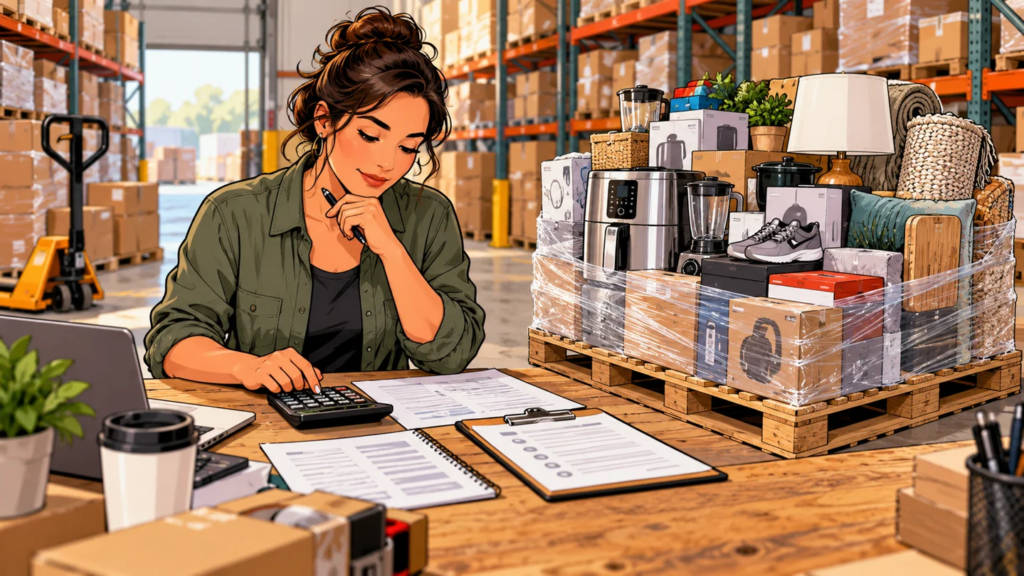
A pallet advertised with $8,000 in retail value and a $600 price tag can look like an easy win. But that gap is not your profit. Freight, selling fees, damaged products, markdowns and the time needed to handle every item all come out of the money you collect.
To calculate liquidation pallet profit before you buy, start with realistic resale revenue and subtract every cost required to buy, receive, prepare and sell the load. Then ask whether the remaining return is worth the time and uncertainty.
This guide follows our article on how to read a liquidation manifest. Once you understand what is listed, the next step is deciding what you can afford to pay.
The Basic Liquidation Pallet Profit Formula
Estimated pallet profit = expected resale revenue − landed inventory cost − selling and operating costs.
For buying decisions, include an allowance for your own labor and a reasonable share of overhead. This is a planning calculation, not a promise of earnings or a substitute for your business accounting.
- Expected resale revenue: the money you reasonably expect to collect from merchandise sold within a defined period.
- Landed inventory cost: the purchase price plus buyer fees, inbound freight and other costs of getting the pallet to you.
- Selling and operating costs: marketplace fees, outbound shipping, supplies, refunds, preparation, labor and overhead associated with selling the load.
Keep your definitions consistent. If you include shipping collected from customers in revenue, include the corresponding postage expense in costs. If your revenue estimate already deducts refunds, do not subtract those same refunds again.
1. Estimate What the Merchandise Will Actually Sell For
A manifest’s original retail value is a starting point for identification, not a resale forecast. Research exact models, sizes and versions, and compare products in a condition similar to what you expect to receive.
Where available, use recent completed sales instead of relying only on asking prices. Account for your selling channel: an item sold locally may bring a different price than one sold online, and each channel has different costs.
Build a simple estimate for each important product group:
Expected revenue = units expected to sell × expected average selling price.
For example, 40 sellable items at an expected average of $25 produce $1,000 in projected revenue. That is still revenue before costs.
Start with the products responsible for most of the load’s value. If one expensive item makes the entire deal look profitable, calculate what happens if that item is missing, incomplete or defective.
2. Separate Sellable Units From the Total Piece Count
A 100-piece pallet does not necessarily provide 100 sales. Some items may need parts, some may only be suitable for a bulk clearance lot, and others may have no recoverable value.
For planning, separate the inventory into three groups:
- Ready to sell: items you expect to list after ordinary inspection and cleaning.
- Needs work or a discount: items requiring testing, parts, repair or a lower selling price.
- No assumed revenue: items too uncertain to value responsibly.
Use the supplier’s written merchandise condition definitions. There is no single safe percentage to apply to every pallet. Your assumptions should reflect the actual category, available evidence and your own results from comparable purchases.
When a product’s revenue is set to zero, its purchase cost still remains in the pallet’s cost. Do not subtract its full hypothetical retail value as a second expense. Add disposal or handling costs separately when relevant.
3. Calculate the Full Landed Cost
The bid or advertised price is only one part of the acquisition cost. Liquidation.com’s buyer guidance identifies the winning price, buyer’s premium, applicable taxes and shipping as components of the total purchase. Check the actual listing and checkout terms for the charges on your order.
- Purchase price or winning bid.
- Buyer’s premium or marketplace purchase fee.
- Inbound freight or your actual pickup costs.
- Delivery services such as a liftgate or a residential delivery surcharge, if quoted.
- Applicable purchase taxes and other required charges.
Get a quote for your actual delivery address and unloading setup before committing. If you collect the pallet yourself, include vehicle rental, fuel, tolls and your pickup time where applicable. Local pickup can reduce freight expenses, but it is not automatically free.
Landed cost per expected sellable unit = total landed cost ÷ expected sellable units.
A $1,060 landed cost divided by 100 listed pieces equals $10.60 per listed piece. If only 80 are expected to be sellable, the more useful planning figure is $13.25 per sellable unit—before selling costs.
4. Count the Costs of Turning Inventory Into Sales
Make a cost list for your actual operation. A garage reseller, flea-market vendor and online seller will have different expenses.
- Selling fees: marketplace, payment processing and any advertising charges you choose to incur.
- Fulfillment: outbound postage, boxes, tape, protective packaging and labels.
- Preparation: cleaning, replacement parts, batteries and testing supplies.
- Returns: expected refunds, return postage and costs you cannot recover.
- Labor: unloading, sorting, testing, photographing, listing, packing and customer service.
- Overhead: a reasonable allocation of storage, utilities, equipment and other business expenses.
Use the current fee schedule for your selling platform and category. A flat percentage can be useful for an initial estimate, but actual fees may include fixed charges or apply to amounts beyond the merchandise price.
A Worked Example: Is This $600 Pallet Profitable?
The following numbers are hypothetical teaching assumptions, not supplier quotes, typical margins or expected results. Assume a pallet contains 100 units. You estimate that 20 will produce no revenue and 80 will sell within 90 days for an average of $25 each. Revenue excludes customer shipping charges and sales tax collected.
| Planning item | Amount |
|---|---|
| Projected revenue: 80 units × $25 | $2,000 |
| Purchase price | $600 |
| Hypothetical buyer’s premium: 10% of $600 | $60 |
| Inbound freight | $300 |
| Other acquisition charges, including any applicable purchase tax | $100 |
| Total landed inventory cost | $1,060 |
| Selling and payment fees: assumed 15% of revenue | $300 |
| Outbound shipping and packing supplies | $120 |
| Refund and return-cost allowance | $80 |
| Preparation supplies and allocated overhead | $100 |
| Owner labor allowance: 12 hours × $20 | $240 |
| Total planning costs, including labor | $1,900 |
| Estimated surplus after the labor allowance | $100 |
Before assigning a value to the owner’s time, this example leaves $340. After allowing $240 for labor, only $100 remains before income taxes or any omitted costs. Calling the full $340 “profit” without explaining the unpaid work would hide an important part of the decision.
The $120 fulfillment allowance is deliberately just an example; it would need to match the actual mix of local and shipped sales. Replace every assumption with your own quote, fee estimate and operating plan.
5. Check the Break-Even Point
Break-even tells you how much revenue you need to cover the costs in your model.
In the example, costs other than the percentage-based selling fees total $1,600. With selling fees assumed at 15% of revenue:
Break-even revenue = $1,600 ÷ (1 − 0.15) = approximately $1,882.35.
Across 80 sales, that is approximately $23.53 per item. An expected selling price of $25 leaves little room for error.
This shortcut works only while the other cost assumptions remain fixed. If shipping, returns or labor change with the number of units sold, update those expenses and recalculate. For a mixed pallet, use the total revenue model rather than assuming every product earns the same amount.
6. Work Backward to Your Maximum Bid
Do not decide your limit from the size of the advertised discount. Decide it from the revenue you can support and the surplus you want to retain after costs.
Maximum bid = (expected revenue − all other costs − desired surplus) ÷ (1 + buyer’s premium rate).
Here, “all other costs” excludes both the bid and the buyer’s premium. The formula assumes the premium is a simple percentage of the bid and other charges are fixed; if additional charges change with your bid, include their actual calculation too.
Using the same example, costs other than the $600 purchase price and $60 premium equal $1,240. If you want a $300 surplus after the labor allowance:
($2,000 − $1,240 − $300) ÷ 1.10 = $418.18 maximum bid.
Round down to a permitted bid increment. At a $600 purchase price, the pallet would not meet this particular target. B-Stock’s bidding guidance likewise encourages buyers to establish a maximum and stick to it.
7. Test a Weaker Outcome Before Buying
A single forecast can make a fragile deal look dependable. Test what happens if fewer items sell, average prices fall or expenses rise.
| Scenario | Revenue | Surplus or loss |
|---|---|---|
| Base case: 80 sales × $25 | $2,000 | $100 |
| Lower prices: 80 sales × $22.50 | $1,800 | −$70 |
| Fewer sales: 70 sales × $25 | $1,750 | −$112.50 |
These comparisons hold the $1,600 of other costs constant and recalculate the 15% selling fee. They are sensitivity checks, not complete forecasts. In practice, adjust fulfillment, labor and return costs to fit each scenario.
If a small change wipes out the surplus, consider a lower offer or a different lot. A deal that depends on every uncertain assumption going your way deserves more scrutiny.
8. Consider How Long Your Money Will Be Tied Up
A forecasted profit is not cash in your account. You may pay for the entire load before you receive it, while sales trickle in over weeks or months.
Choose a planning window, such as 30, 60 or 90 days, and estimate what is likely to sell during that period. Inventory left on a shelf may still have value, but do not count it as collected revenue. Track remaining stock separately and plan any markdown or bulk-clearance strategy.
Also ask whether you can afford the next order while this one is still selling. Storage space, available cash and your capacity to process merchandise can matter as much as the projected dollar surplus.
Rob’s Take: Know Your Walk-Away Price
A pallet does not become a good deal just because someone else wants it. Write down what you expect to collect, what the work will cost and the most you can pay. When the price moves past that limit, let the numbers make the decision.
Your Before-You-Buy Checklist
- Research the exact products and realistic resale prices.
- Review the manifest and the seller’s condition definitions.
- Estimate sellable units and likely sales within a defined period.
- Get a complete landed-cost quote.
- Include fees, fulfillment, returns, preparation, labor and overhead.
- Calculate break-even revenue and your maximum bid.
- Test a lower-price or lower-sales scenario.
- Save your assumptions and compare them with actual results after selling.
The goal is not to make your spreadsheet justify the pallet. The goal is to discover whether the pallet fits your business before you spend the money.
Continue learning through the FREE Buyer Academy, or browse the Liquidators Guide supplier directory to research potential sources. Evaluate each supplier and each individual load before purchasing.
Sources and Further Reading
- Liquidation.com: Buyer FAQ — purchase costs and shipping arrangements.
- B-Stock: Online Bidding for Beginners — buyer fees and setting a maximum bid.

Your Next Pallet Purchase Starts With Better Preparation.
Learn how to evaluate suppliers, understand merchandise conditions, and review liquidation manifests. Sign up for the FREE Buyer Academy and complete the lessons before your next purchase.
Already enrolled? Keep going—complete your training before you buy.

Rob has been involved in the liquidation and secondary-market industry since 2002. Over the course of his career, he has brokered and exported liquidation pallets and truckloads of merchandise throughout the United States and has worked extensively with closeouts, shelf pulls, customer returns, and other secondary-market inventory.