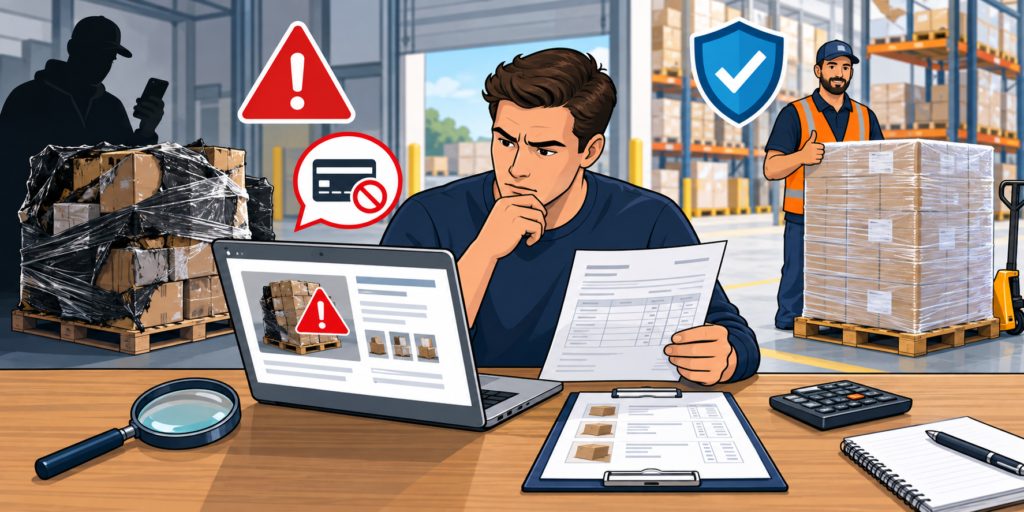
The liquidation industry offers legitimate opportunities for resellers to purchase customer returns, shelf pulls, overstock, closeouts, and other discounted merchandise. Unfortunately, the industry also attracts scammers who understand how appealing a low-priced pallet can be to a new buyer.
A scammer may advertise pallets supposedly filled with electronics, tools, appliances, or name-brand merchandise at prices far below the market. The listing may include professional photographs, convincing testimonials, copied warehouse videos, and even the name of a real liquidation company.
Once payment is sent, the seller may disappear, provide a false tracking number, demand additional fees, or deliver merchandise that bears little resemblance to what was advertised.
Learning how liquidation pallet scams work can help you protect your inventory budget before a fraudulent seller gets your money.
What Is a Liquidation Pallet Scam?
A liquidation pallet scam occurs when a seller intentionally misrepresents its identity, inventory, transaction terms, or ability to deliver merchandise.
Common versions include:
- Advertising inventory that does not exist
- Impersonating a legitimate liquidation company
- Using stolen photographs or videos
- Collecting payment and never shipping anything
- Sending worthless merchandise instead of the advertised products
- Falsifying or altering a manifest
- Creating fake shipping or tracking information
- Demanding additional money after payment
- Claiming that nonexistent customs, insurance, or release fees must be paid
- Selling the same load to multiple buyers
Not every disappointing pallet is a scam. Liquidation merchandise naturally carries risk, especially when inventory consists of customer returns or uninspected products. A load containing damaged or incomplete merchandise may be a poor purchase without necessarily being fraudulent.
The important question is whether the supplier truthfully represented the merchandise and followed the written terms of the sale.
Scam #1: The Too-Good-to-Be-True Pallet
One of the most common warning signs is an unrealistic offer.
A social media advertisement may promise a pallet containing new televisions, laptops, power tools, gaming systems, or major appliances for a few hundred dollars—including shipping.
Professional liquidation suppliers generally understand the wholesale value of their merchandise. Although exceptional deals exist, desirable inventory is rarely sold for a tiny fraction of its realistic recoverable value without a good reason.
Before buying, ask yourself:
- Why would the supplier sell this merchandise so cheaply?
- Is the advertised price consistent with similar loads?
- Does the price include freight, or will more charges appear later?
- Are the items shown guaranteed, or are the photographs only examples?
- Is the seller using the original retail value to make an ordinary load appear extraordinary?
Do not let the fear of missing out replace basic due diligence. The Federal Trade Commission identifies pressure to hurry as a common scam warning sign because it prevents potential victims from taking time to investigate.
Scam #2: Stolen Pallet Photographs
Scammers frequently copy attractive photographs from legitimate wholesalers, retailers, auctions, and reseller groups.
A photograph proves only that a pallet existed somewhere when the picture was taken. It does not prove that the person using the photograph owns the merchandise or has permission to sell it.
Use a reverse-image search to see whether the same picture appears on other websites or older listings. Pay close attention when identical photographs are connected to several unrelated company names or locations.
Ask the seller for new photographs showing:
- Your name or business name on a handwritten card
- The current date
- The pallet identification number
- Multiple sides of the pallet
- Close-up views of labels and merchandise
- The surrounding warehouse area
For a significant purchase, request a live video call. Ask the representative to walk from the office to the merchandise and show the pallet continuously.
A legitimate supplier may have reasonable security or confidentiality restrictions, but it should be able to provide credible evidence that it controls the inventory being offered.
Scam #3: Impersonating a Real Liquidation Company
A scammer does not always invent a company. It may impersonate an established liquidation business.
The scammer may copy the real company’s:
- Business name
- Logo
- Website photographs
- Warehouse address
- Staff names
- Product descriptions
- Business-registration information
The fraudulent listing then substitutes a different telephone number, email address, social media account, or payment destination.
Never verify a seller using only the information provided in the message that introduced the deal. Search for the company independently and contact it through a telephone number or email address found on its established website or official business listing.
Ask the company to confirm:
- The salesperson works there
- The merchandise is being offered by the company
- The invoice number is valid
- The payment instructions are correct
- The receiving account belongs to the company
If the person contacting you claims to represent a known supplier but asks you to pay an individual or unrelated company, stop the transaction until the discrepancy is independently resolved.
Scam #4: The Fake Warehouse
A website may claim that a business operates from a large distribution center when the listed address is actually a private residence, mailbox store, vacant building, or unrelated warehouse.
Search the address through online maps, property information, business directories, and official registration records.
Then call the warehouse using an independently located telephone number. If practical, visit the facility or hire someone nearby to inspect it.
Some legitimate brokers do not own warehouses. They arrange transactions between buyers, retailers, manufacturers, and third-party facilities. Brokering is not inherently suspicious, but the seller should clearly disclose its role.
A broker claiming to own merchandise or facilities that it does not control is a different matter.
Scam #5: Fake or Misleading Manifests
A professional-looking spreadsheet is easy to create or alter.
Scammers may:
- Copy a manifest from another load
- Inflate original retail prices
- Add high-value products that are not present
- Change quantities
- Remove low-value merchandise
- Present an estimated manifest as exact
- Reuse one manifest for several buyers
- Combine information from unrelated loads
Before relying on a manifest, ask whether it was produced by the originating retailer, warehouse, broker, or supplier.
Check a sample of the model numbers and retail prices. Pay particular attention to the products responsible for most of the load’s claimed value.
The invoice should identify whether the manifest is guaranteed, estimated, or provided only as a reference. It should also explain what remedy, if any, is available when the shipment differs substantially from the manifest.
Never calculate potential profit from the manifest’s total retail value alone. Your resale value may be considerably lower after accounting for condition, age, missing accessories, platform fees, labor, and unsellable merchandise.
Scam #6: The Bait-and-Switch Load
In a bait-and-switch transaction, the seller displays or describes desirable merchandise but ships a different and much less valuable load.
The buyer may receive:
- Unsellable clothing
- Broken electronics
- Empty or incomplete packaging
- Extremely old merchandise
- Products from different categories
- Excessive quantities of one slow-moving item
- Salvage goods advertised as overstock
- Loose merchandise instead of the wrapped pallet shown
Before paying, connect the photographs, manifest, invoice, and pallet identification number to the exact load being purchased.
Save copies of every advertisement and representation. If the load is shipped by freight, photograph or record the pallet before removing the wrapping. Document the shipping label, pallet condition, contents, shortages, and visible damage.
Scam #7: Fraudulent Payment Instructions
Payment is often the point at which an otherwise convincing transaction becomes dangerous.
Scammers prefer payment methods that move money quickly and offer limited opportunities for recovery. The FTC specifically warns about demands for payment through wire transfers, cryptocurrency, gift cards, and certain payment applications.
Bank wires are used in legitimate wholesale transactions, particularly for truckloads. The use of a wire does not automatically prove fraud. However, buyers should recognize that recovering a voluntarily authorized wire can be extremely difficult.
Before sending money:
- Confirm the receiving name matches the supplier
- Call a known company number to verify the instructions
- Ask why payment is going to another company or individual
- Examine the email domain for subtle misspellings
- Confirm any last-minute account change independently
- Keep a copy of the invoice and payment instructions
- Never pay using gift cards
- Be extremely cautious about cryptocurrency payments
Cryptocurrency transactions typically lack the dispute protections available with credit and debit cards.
The FBI recommends verifying payment changes through a known telephone number or in person because criminals can compromise real business email accounts and substitute fraudulent payment information.
Scam #8: The Surprise Shipping Fee
Some fraudulent sellers advertise an unusually low delivered price and then request additional payments after the buyer has already committed money.
The seller may claim the shipment is being held until the buyer pays for:
- Insurance
- Customs clearance
- Warehouse release
- A delivery permit
- Taxes
- Pallet certification
- Additional postage
- A refundable security deposit
- An account upgrade
Ask for a complete landed-price quote before paying. The quote should identify the merchandise price, freight, buyer’s premium, taxes, liftgate charges, residential fees, appointment fees, and any other expected expense.
Contact the freight carrier independently if you receive an unexpected payment demand. Do not use only the telephone number included in a suspicious message.
Scam #9: Fake Tracking Information
A tracking number does not necessarily prove that your merchandise has shipped.
A scammer may provide:
- A completely fabricated number
- Tracking belonging to another shipment
- A label created without the merchandise being collected
- A number for a small parcel instead of a pallet
- A link to a fake carrier website
Enter the number directly on the carrier’s official website rather than clicking a link in the seller’s message.
Confirm that the shipment’s origin, destination, weight, and service type make sense. A truckload will not move through the same system as a small parcel.
When purchasing freight-shipped merchandise, ask for the bill of lading and the carrier’s name. Contact the carrier through its independently verified number when necessary.
Scam #10: Recovery Scams
A buyer who has already lost money may be targeted again.
Someone may claim to be an investigator, attorney, government employee, payment specialist, or recovery service that can retrieve the stolen funds for an upfront fee. The person may even know details about the original transaction.
Never assume that a recovery offer is legitimate because the caller knows how you were scammed. Victim information may be shared or sold among criminals.
Government agencies do not guarantee recovery in exchange for gift cards, cryptocurrency, or unexpected upfront payments.
How to Protect Yourself Before Buying
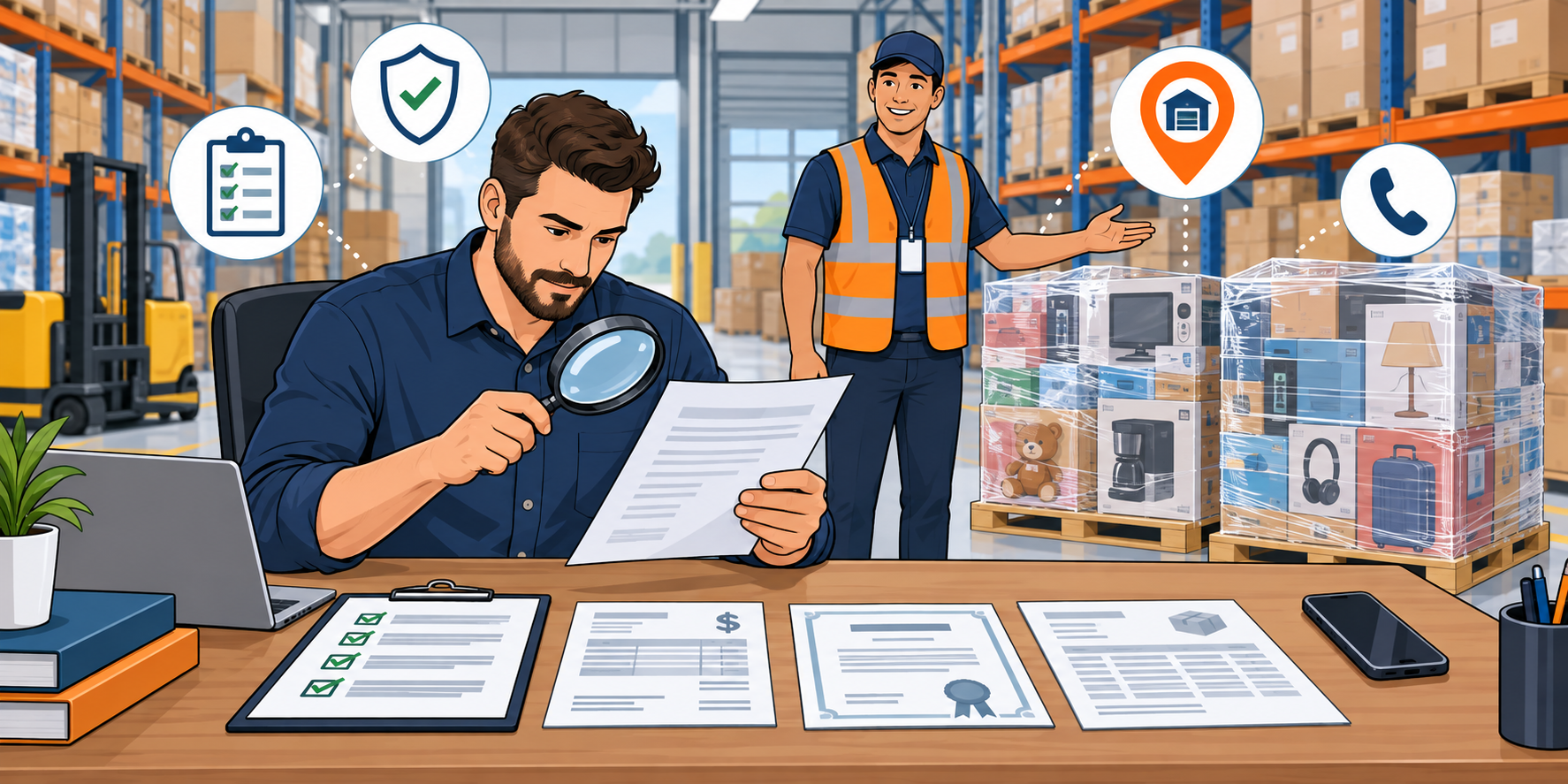
Use a repeatable verification process for every new supplier.
Confirm the business
Verify the legal business name, registration status, address, telephone number, website domain, and identity of the representative.
Investigate its reputation
Search reviews, complaints, scam reports, lawsuits, reseller discussions, and BBB Scam Tracker reports. BBB Scam Tracker provides a searchable collection of reported scams.
Confirm the merchandise
Request current photographs, pallet numbers, labels, a live warehouse video, and written confirmation that the seller is authorized to sell the load.
Review the terms
Understand the condition, manifest accuracy, resale restrictions, shipping terms, claims process, and return policy.
Verify the payment
Confirm payment instructions using an independently obtained telephone number, especially when wiring money or when instructions change.
Start small
When possible, place a smaller test order before committing to a truckload or expensive recurring purchase.
Preserve evidence
Save listings, messages, emails, manifests, invoices, photographs, videos, payment records, tracking details, and the seller’s contact information.
The Liquidation Pallet Scam Checklist
Do not send payment until you can answer yes to these questions:
- Is the supplier’s legal business identity confirmed?
- Does the address match the company’s claims?
- Have I contacted the business independently?
- Does the salesperson actually work for the company?
- Have I searched for complaints and scam reports?
- Do I have current proof that the merchandise exists?
- Is the exact pallet or load identified?
- Do I understand the merchandise condition?
- Have I reviewed the manifest for unrealistic values?
- Do I have a detailed invoice?
- Are all freight and additional fees disclosed?
- Does the payment recipient match the seller?
- Have I independently confirmed the payment instructions?
- Can I afford the potential loss if the load underperforms?
- Have I saved copies of all transaction records?
If several answers are no, pause the transaction.
What to Do If You Paid a Scammer
Act immediately. The longer you wait, the more difficult recovery may become.
- Contact your bank, card issuer, payment application, wire service, or cryptocurrency platform.
- Explain that the transaction was fraudulent.
- Ask whether the payment can be stopped, recalled, disputed, or reversed.
- Preserve all advertisements, messages, receipts, account information, and shipping records.
- Report the incident to the platform where the supplier was advertised.
- File a report with the FTC at ReportFraud.ftc.gov.
- Report internet-related fraud to the FBI’s Internet Crime Complaint Center at IC3.gov.
- Consider contacting local law enforcement.
- Warn other resellers using factual, documented information.
The FTC recommends contacting the company that handled the payment immediately and requesting reversal when possible.
Avoid exaggerating or making claims you cannot substantiate when posting a public warning. Describe what was promised, what you paid, what occurred, and what documentation you possess.
Final Thoughts
Liquidation pallet scams succeed because they combine attractive merchandise, low prices, urgency, and the possibility of profit.
The safest response is to slow the transaction down.
Verify the company independently. Confirm that the inventory exists. Review the manifest and written terms. Calculate the true landed cost. Confirm payment instructions through a trusted contact method. Walk away when the seller refuses reasonable verification or pressures you to act before you are comfortable.
There will always be another pallet. Protecting your working capital is more important than chasing a deal that does not withstand basic scrutiny.
Frequently Asked Questions
Are liquidation pallets advertised on social media legitimate?
Some legitimate suppliers advertise through social media, but an advertisement alone does not verify the company or merchandise. Research the business independently and complete the same verification process you would use for any unfamiliar supplier.
How can I tell whether pallet photographs are stolen?
Run the images through a reverse-image search, look for the same pictures on older websites, and request new photographs containing your name, the current date, and the pallet number. A live warehouse video provides stronger evidence.
Is it safe to pay for a pallet by bank wire?
Legitimate wholesalers may accept wires, but wire payments can be difficult to recover. Confirm the seller, invoice, bank-account name, merchandise, and payment instructions before sending funds.
What is the biggest sign of a pallet scam?
No single sign proves fraud, but unrealistic pricing combined with urgency, unverifiable inventory, and irreversible payment demands is especially concerning.
Is a disappointing liquidation pallet always a scam?
No. Liquidation purchases involve condition and resale risks. A poor-quality load becomes potentially fraudulent when the seller intentionally misrepresents the merchandise, substitutes the load, falsifies documents, or violates the agreed transaction terms.

Rob has been involved in the liquidation and secondary-market industry since 2002. Over the course of his career, he has brokered and exported liquidation pallets and truckloads of merchandise throughout the United States and has worked extensively with closeouts, shelf pulls, customer returns, and other secondary-market inventory.