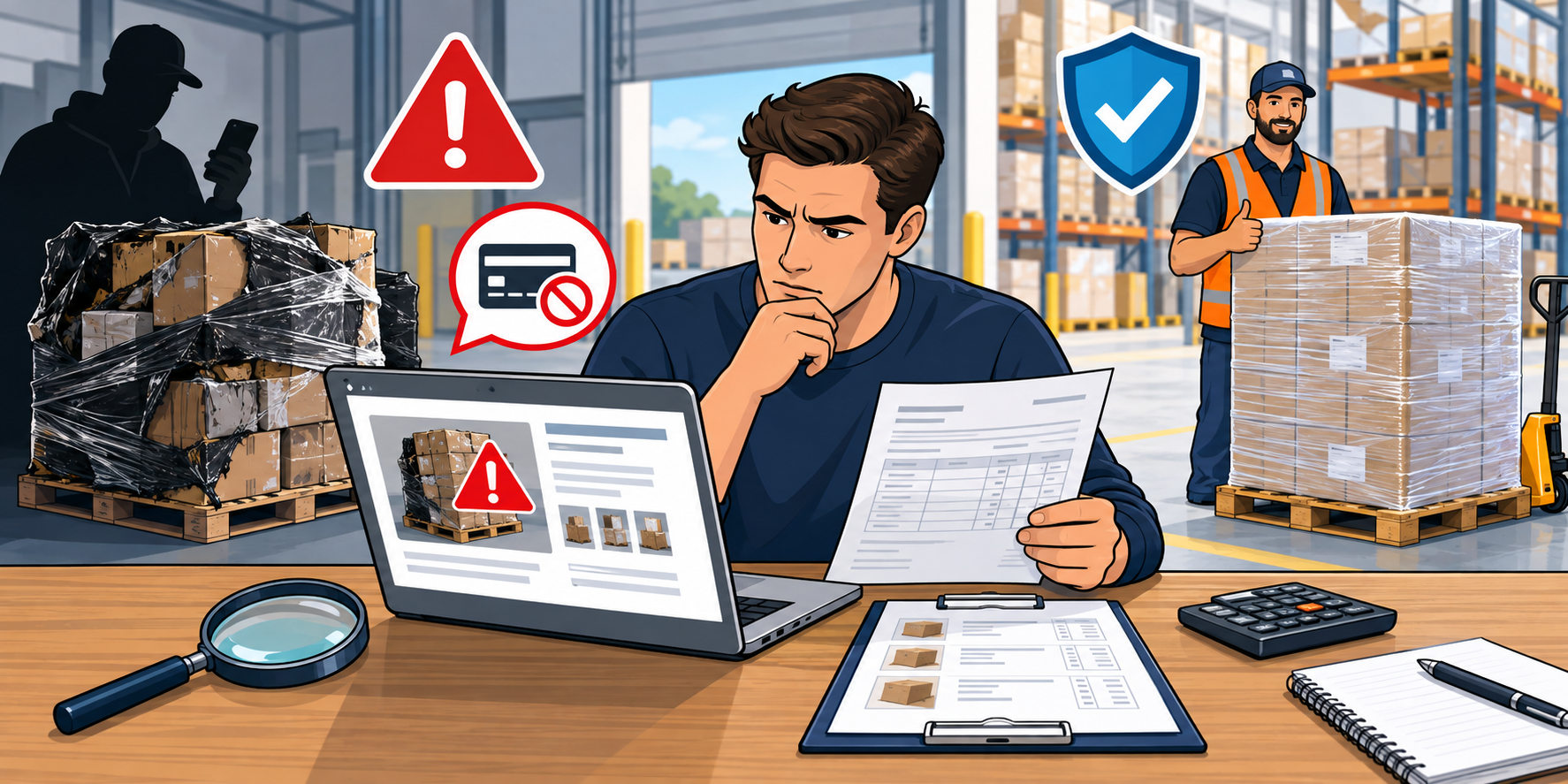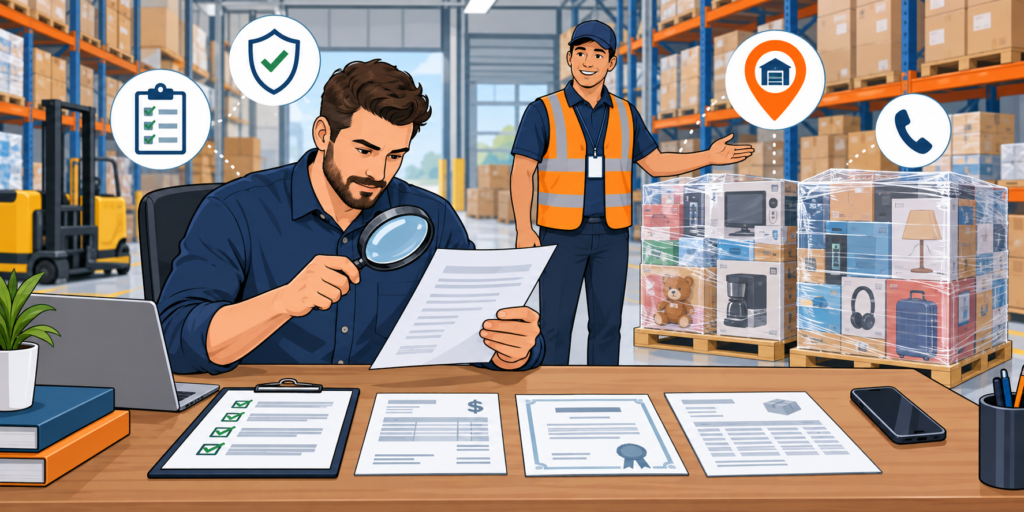
Buying liquidation merchandise can be a profitable way to acquire inventory for resale, but choosing the wrong supplier can turn an exciting opportunity into an expensive mistake.
A professional-looking website, active social media account, or impressive collection of pallet photographs does not automatically prove that a supplier is legitimate. Photographs can be copied, reviews can be manipulated, and dishonest sellers may impersonate real liquidation companies.
Before purchasing a pallet, case lot, or truckload, you need to investigate both the company and the specific merchandise being offered. Supplier vetting does not eliminate every risk associated with liquidation inventory, but it can help you avoid preventable losses and make better buying decisions.
Here is how to properly vet a liquidation supplier before sending money.
1. Verify the Supplier’s Legal Business Name
Start by asking for the supplier’s complete legal business name. This may be different from the brand name displayed on its website or social media pages.
You should also request:
- Physical business address
- Business telephone number
- Company email address
- Name of the owner or authorized representative
- State in which the business is registered
- Business entity type, such as an LLC or corporation
- Applicable resale, sales-tax, or business-license information
Search for the company through the Secretary of State or other official business registry in the state where it claims to operate. Most states require corporations and limited liability companies to register with a state business office, although requirements vary by business structure and location.
Confirm that the company’s name, status, address, and registered agent are consistent with the information supplied to you.
Remember that business registration alone does not prove that a company is reputable. It simply helps establish that the business exists under the stated name.
2. Confirm the Physical Location
A legitimate liquidation supplier should be able to explain where its merchandise is stored and shipped from.
Enter the address into Google Maps or another mapping service. Look at the property and ask:
- Does the address appear to be a warehouse or commercial location?
- Is it a private residence, mailbox store, vacant lot, or unrelated business?
- Does the company name appear in available signage or directory information?
- Is the location consistent with the amount of inventory being advertised?
A residential address is not automatically disqualifying. Some brokers and smaller wholesalers operate from home offices and arrange for merchandise to ship from third-party warehouses. However, the supplier should clearly explain this arrangement.
If the supplier claims to own a large warehouse filled with merchandise but the address leads to a mailbox or vacant property, proceed carefully.
3. Verify the Contact Information Independently
Do not rely exclusively on the contact information provided in a social media message or unsolicited email.
Search for the company independently and compare:
- Telephone numbers
- Email addresses
- Website domains
- Physical addresses
- Social media accounts
- Names of company representatives
Call the publicly listed telephone number and ask to speak with the salesperson who contacted you. This can help uncover someone impersonating a legitimate supplier.
Business impersonation is a significant fraud category, so confirming that you are communicating with the real company is essential.
Be cautious when a salesperson uses only a free email address instead of an address connected to the company’s website domain. A Gmail or Yahoo address does not prove fraud, especially for a small business, but it warrants additional verification.
4. Examine the Company’s Website
A website should be treated as one piece of evidence—not final proof of legitimacy.
Review the site carefully for:
- A consistent business name and address
- A working telephone number
- A company-domain email address
- Clear product descriptions
- Shipping and pickup information
- Terms and conditions
- Refund or dispute policies
- Privacy and contact pages
- Original warehouse and merchandise photographs
Look for copied text, inconsistent company names, unusually low prices, spelling problems, and pages that appear unfinished.
You can also research when the website’s domain was registered. A company claiming decades of experience while operating a website created only a few weeks ago deserves closer examination. However, a recently registered domain is not conclusive because an established company may have changed its name or rebuilt its website.
5. Investigate Reviews Across Multiple Platforms
Never base your decision on testimonials displayed only on the supplier’s website.
Search the company name along with terms such as:
- Reviews
- Complaints
- Scam
- Fraud
- Lawsuit
- Pallet review
- Truckload review
- Shipping problem
- Missing merchandise
Check several sources, including Google, the Better Business Bureau, industry groups, reseller communities, and relevant social media platforms. The BBB directory allows users to review business ratings, customer reviews, and complaint information, while BBB Scam Tracker contains reports of potentially fraudulent activity.
Pay attention to patterns rather than one isolated comment.
Repeated complaints involving nondelivery, substituted merchandise, altered manifests, unauthorized charges, or an inability to contact the supplier are more concerning than a single complaint about normal liquidation conditions.
Reviews should still be treated cautiously. Positive reviews may be fake, while negative reviews do not always provide the full story. Examine how specific the reviews are, whether they appear to come from actual buyers, and how the supplier responds to criticism.
6. Ask for Recent Buyer References
Ask the supplier for references from businesses that recently purchased similar inventory.
Useful questions for a reference include:
- What type of load did you purchase?
- Did the merchandise match its description?
- Was the manifest reasonably accurate?
- Did the shipment arrive on time?
- Were there unexpected freight charges?
- How did the supplier handle problems?
- Would you buy from the company again?
A reference supplied by the seller is not completely independent, but it gives you another opportunity to compare the supplier’s claims.
You may also ask about the supplier in established reseller groups. Be specific. Instead of asking, “Is this company legitimate?” ask whether members have completed recent transactions, what they purchased, and what condition the merchandise arrived in.
7. Confirm That the Inventory Actually Exists
Stolen pallet photographs are common in online scams. A seller may copy images from another wholesaler, auction, retailer, or old social media post.
Ask for current photographs or video showing:
- The complete pallet or load
- Multiple sides of the merchandise
- Pallet labels
- Case labels
- Visible condition issues
- The warehouse environment
- A handwritten note displaying the current date and your name or company name
For a large purchase, request a live video call from the warehouse. During the call, ask the representative to show the merchandise continuously rather than sending a prerecorded clip.
If feasible, inspect the merchandise in person or hire a local third party to perform an inspection.
Photographs and video prove only that inventory was present at a particular location. You must still confirm that the person offering it has the authority to sell it.
8. Understand Exactly What Is Being Sold
Liquidation terms are not always used consistently. Words such as “returns,” “shelf pulls,” “overstock,” “tested,” “uninspected,” and “salvage” can mean different things to different sellers.
Ask the supplier to define the condition in writing.
Find out:
- Whether the merchandise has been inspected
- Whether products have been tested
- Whether items may be incomplete or damaged
- Whether packaging damage is expected
- Whether customer data has been removed from electronics
- Whether the merchandise includes recalled, expired, restricted, or hazardous products
- Whether retailer labels or identifying marks must be removed
- Whether resale restrictions apply
Do not assume that “overstock” means brand-new retail-ready merchandise or that “returns” means products are functional.
9. Review the Manifest Carefully
A manifest can help you estimate the potential value of a load, but it should not be accepted without questions.
Confirm whether the manifest is:
- Original or created by the supplier
- Itemized or summarized
- Exact or estimated
- Based on retail value, wholesale value, or another measure
- Connected to the specific load being offered
- Guaranteed or provided only as a general reference
Check product quantities, model numbers, descriptions, retail values, and duplicate items. Search a sample of higher-value products to determine whether the listed retail prices are realistic and current.
Ask what happens if the actual shipment differs substantially from the manifest. Any guarantee or adjustment policy should appear in the written purchase terms.
An unmanifested load is not necessarily a bad purchase, but it carries greater uncertainty and should be priced accordingly.
10. Request a Complete Written Quote
Before paying, obtain a written quote or invoice that identifies:
- Seller’s legal business name
- Buyer’s name or company
- Description of the merchandise
- Pallet or load identification number
- Merchandise condition
- Quantity or estimated piece count
- Purchase price
- Buyer’s premium, if applicable
- Freight charges
- Liftgate, residential, or appointment fees
- Taxes
- Payment method
- Shipping location
- Delivery or pickup terms
- Claims procedure
- Return or refund policy
Avoid agreements based entirely on telephone conversations or disappearing social media messages.
Save copies of advertisements, photographs, manifests, emails, invoices, payment records, and written promises. These records may be important if a dispute occurs.
11. Evaluate the Payment Method
How a supplier asks you to pay can reveal a great deal about the transaction.
The Federal Trade Commission warns businesses to be especially cautious when someone demands payment by wire transfer, cryptocurrency, or gift card.
Liquidation companies sometimes legitimately accept bank wires, particularly for truckload transactions. However, wires generally provide limited recourse after the funds have been sent.
Before wiring money:
- Verify the company and merchandise thoroughly
- Confirm the wiring instructions by calling a known company number
- Make sure the bank-account name matches the seller’s legal identity
- Be suspicious of last-minute changes to payment instructions
- Never send funds to an unrelated individual without a documented explanation
- Confirm that the invoice and payment instructions came from the real supplier
Credit cards may provide additional dispute options, although availability and protections depend on the transaction and card issuer. Do not assume that a payment platform guarantees the quality, authenticity, or delivery of liquidation merchandise.
12. Start With a Smaller Purchase
When possible, place a smaller test order before purchasing a full truckload.
Use the first transaction to evaluate:
- Communication
- Invoice accuracy
- Merchandise condition
- Manifest reliability
- Packaging
- Shipping speed
- Freight coordination
- Customer service
- Claims handling
A successful small order does not guarantee that every future purchase will go smoothly, but it allows you to evaluate the supplier while limiting your initial exposure.
If the supplier pressures you to skip a test order and immediately purchase a large load, ask why.
13. Calculate the Entire Landed Cost
A load can appear profitable until freight, labor, damaged goods, storage, platform fees, and disposal expenses are included.
Calculate:
Purchase price + freight + accessorial charges + unloading + storage + processing labor + repairs + disposal costs = total landed cost
Then estimate realistic recoverable value rather than relying on the load’s original retail value.
Retail value is not the same as resale value. Liquidation merchandise may include outdated models, missing accessories, damaged packaging, slow-moving products, incomplete sets, or unsellable items.
A trustworthy supplier can still sell a load that is wrong for your business. Supplier legitimacy and load profitability are two separate questions.
14. Watch for Common Warning Signs
Proceed cautiously if you encounter several of these warning signs:
- Prices dramatically below the rest of the market
- Pressure to pay immediately
- Refusal to provide a legal business name
- Payment requested to an unrelated person
- Communication limited to encrypted messaging apps
- Recently created or inconsistent social media accounts
- Copied warehouse or pallet photographs
- Refusal to conduct a live video call
- No written invoice or sales terms
- Address information that cannot be confirmed
- Claims of guaranteed profits
- Claims that every item is new, valuable, and fully functional
- Refusal to explain merchandise condition
- Constantly changing payment instructions
- Demands for gift cards or cryptocurrency
- A deal that changes after you agree to buy
One warning sign may have an innocent explanation. Several warning signs appearing together should cause you to pause or walk away.
A Simple Liquidation Supplier Vetting Checklist
Before sending payment, confirm that you have:
- Verified the supplier’s legal business name
- Checked the appropriate state business registry
- Confirmed the physical address
- Called a publicly listed telephone number
- Compared website, email, and social media information
- Searched reviews and complaint records
- Checked BBB Scam Tracker
- Requested recent buyer references
- Confirmed that the inventory exists
- Reviewed current photographs or live video
- Understood the merchandise condition
- Examined the manifest
- Received a complete written invoice
- Reviewed shipping, claims, and refund terms
- Confirmed payment instructions independently
- Calculated the total landed cost
- Considered placing a smaller test order
Final Thoughts
Vetting a liquidation supplier requires more than checking whether the company has a website or a few positive reviews.
Your goal is to build a consistent body of evidence. The legal business name, physical location, contact information, inventory photographs, manifest, invoice, payment account, reviews, and representative’s identity should all point to the same company and transaction.
Even a legitimate supplier cannot remove the inherent risk from customer returns, salvage merchandise, or uninspected loads. Proper vetting helps you separate the normal risks of liquidation buying from warning signs of misrepresentation or fraud.
When a seller avoids reasonable questions, refuses to document the deal, or pressures you to send irreversible payment, walking away may be your most profitable decision.
Frequently Asked Questions
How do I know whether a liquidation company is legitimate?
Verify the company through official state records, confirm its physical location and contact information, investigate independent reviews, request references, and obtain current proof that the inventory exists. No single check proves legitimacy, so compare multiple sources.
Can liquidation supplier reviews be trusted?
Reviews can provide useful information, but they should not be your only form of verification. Look for detailed reviews across multiple platforms and pay attention to repeated patterns involving delivery, manifests, merchandise condition, and customer service.
Should I wire money for a liquidation pallet?
Bank wires are used in legitimate wholesale transactions, but they usually provide limited options for recovering funds. Verify the company, merchandise, invoice, bank-account name, and wiring instructions before sending money.
What should I ask a liquidation supplier before buying?
Ask about merchandise condition, inspection and testing, manifest accuracy, source, resale restrictions, shipping costs, claims procedures, payment requirements, and what happens if the shipment differs from its description.
Is a business license proof that a supplier is trustworthy?
No. Registration or licensing helps confirm that a business exists, but it does not guarantee honest practices, quality merchandise, or a profitable transaction. It should be one part of a broader verification process.

Rob has been involved in the liquidation and secondary-market industry since 2002. Over the course of his career, he has brokered and exported liquidation pallets and truckloads of merchandise throughout the United States and has worked extensively with closeouts, shelf pulls, customer returns, and other secondary-market inventory.